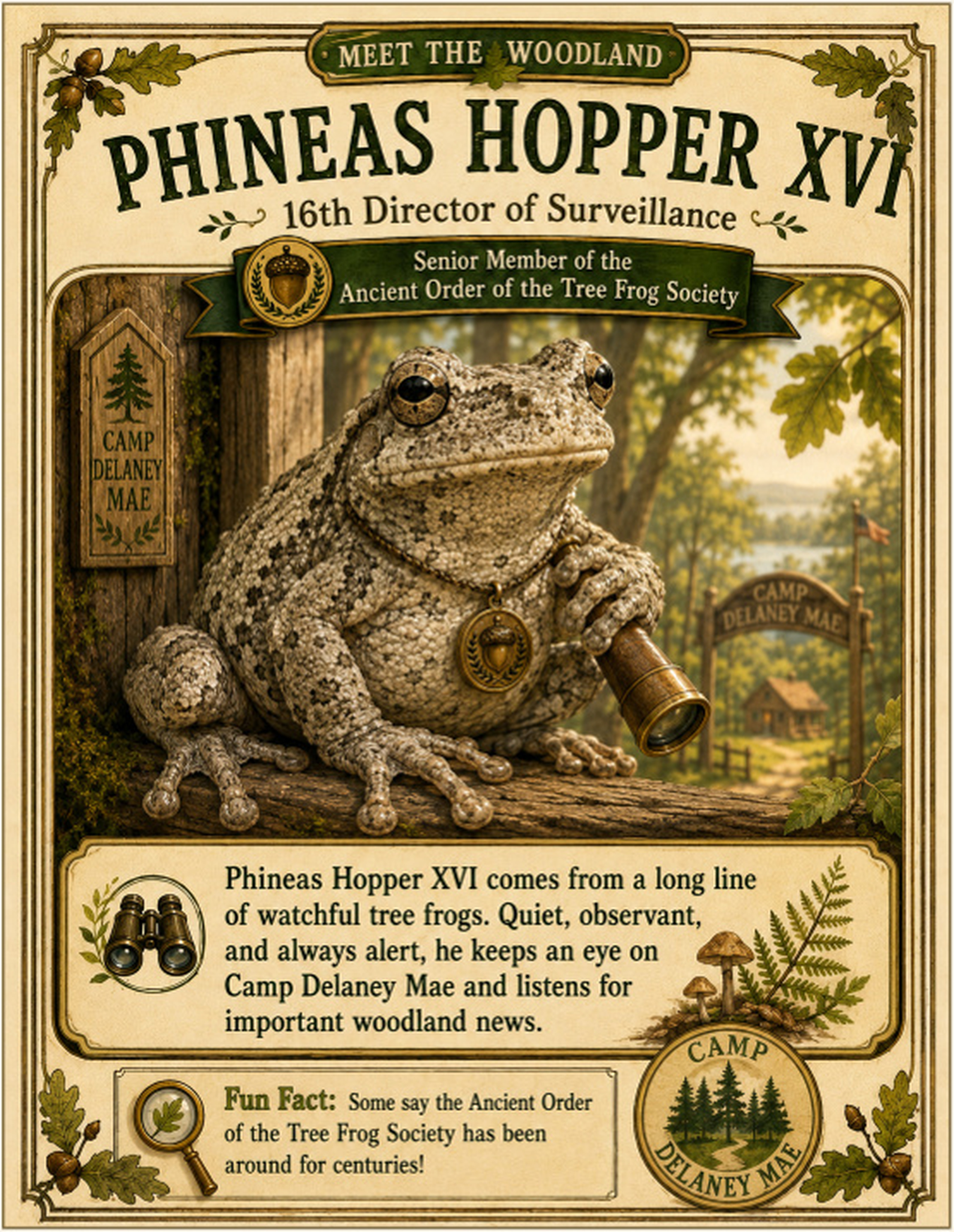
Sixteen generations of watchers.
Members of the Ancient Order are known for extraordinary powers
of observation, uncanny camouflage, and a natural ability to
recruit dependable watchers.
Phineas is very clear about one thing:
They are watchers. Not spies.
A watcher observes, remembers, and reports. Nothing more.
Sometimes the best hiding place is in plain sight.
The Hopper family's ability to camouflage is uncanny. Bark,
moss, leaves, shadows—it makes little difference. A properly
trained Tree Frog can remain in plain sight without anyone
realizing he is there.
Phineas considers this perfectly normal.
“Hmph.”
There are stories about the Hopper family.
Phineas's formal British manner of speaking—and even the famous
family “Hmph”—has apparently been passed down through generations.
One old family story claims that an early Phineas spent
considerable time perfectly camouflaged somewhere inside
Winston Churchill's office.
Phineas neither confirms nor denies it.
Then there is the D-Day rumor.
According to one persistent story, members of the Ancient Order
may have assisted with deception and diversion efforts surrounding
the D-Day invasion during World War II.
No proof has ever surfaced.
When questioned about it, Phineas usually pauses and replies:
“Certain family matters remain classified. Hmph.”
You will never know everything about Phineas.
How much of the Hopper family history is true?
Nobody really knows.
And with Phineas Hopper XVI, that may be exactly the point.
The more you learn about him, the more you begin to suspect
there is still quite a bit you don't know.
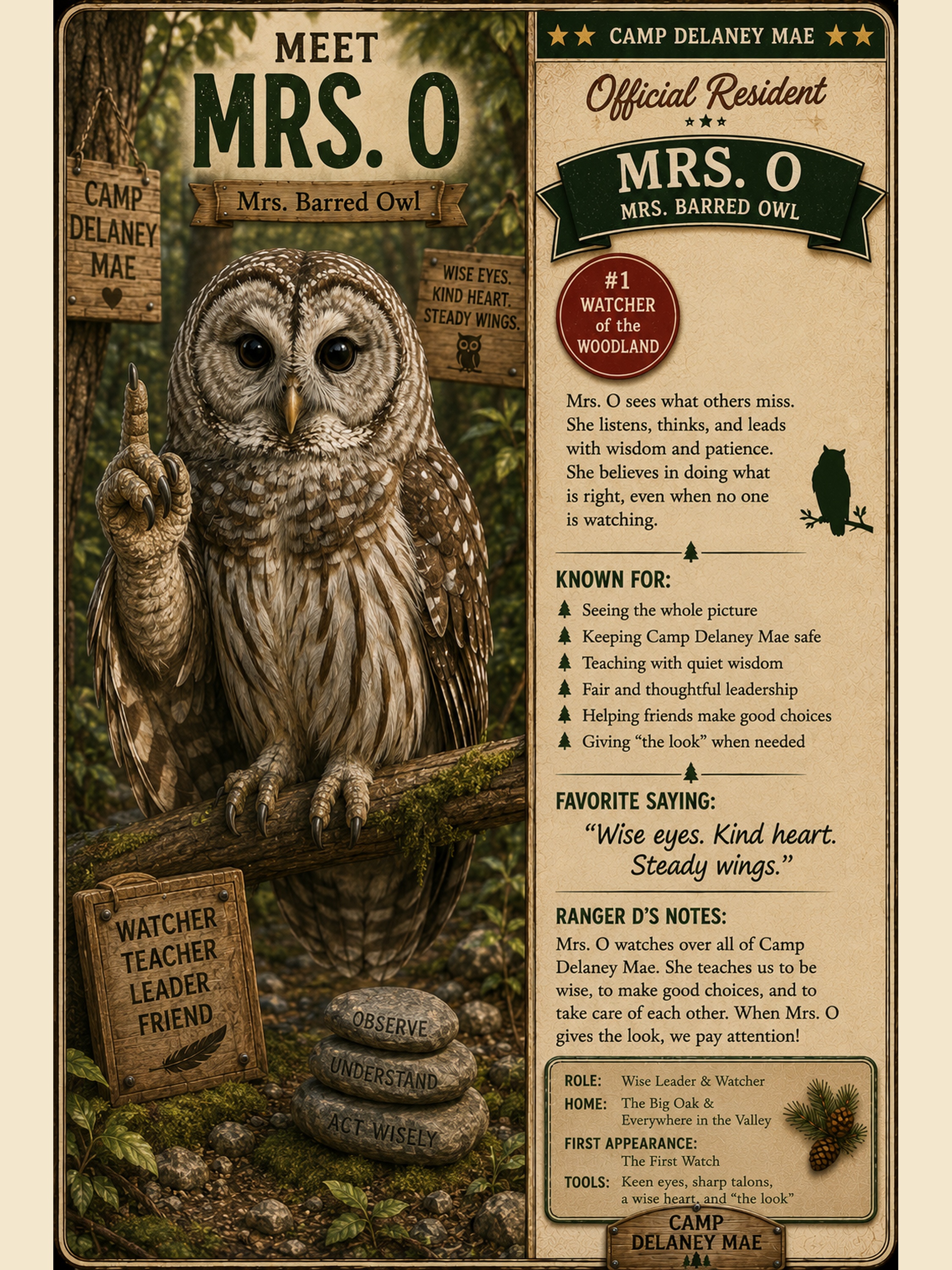
She watches before she acts.
That quiet attention may be the quality that defines Mrs. O best.
In The Beginning, we learn that she
notices things others miss and pays attention when it matters.
She does not need to be involved in every problem to know when
her presence is truly needed.
She looks for the truth before passing judgment.
Mrs. O is never satisfied with the loudest version of a story.
In More Than a Stripe, she remembers
what really happened to Howard when fear turned an innocent moment
into a lasting rumor. She reminds him that the truth can be quieter
than the story everyone repeats—and that sometimes truth takes time
to repair what fear has broken.
She believes kindness and responsibility belong together.
Mrs. O can be compassionate without ignoring poor choices.
In One-Eyed Sam, she reminds Sam
that he had been shown mercy, safety, and trust—and then makes him
face the harm he caused. She does not give up on him, but neither
does she allow him to hide from what he has done.
She teaches instead of simply taking over.
Mrs. O often helps others discover the right answer for themselves.
In Birdland, she teaches Walnut Willie
that leadership is not only about taking care of your own group.
A leader must also understand when his choices could hurt everyone else.
In It's All Nuts!, she says almost
nothing while Willie slowly realizes that clearing the Woodland paths
matters more than adding to his own walnut pile.
She believes good leadership begins with listening.
When Camryn returns in Seeds of Change,
Mrs. O watches her help a young rabbit solve a problem without taking
over. Her quiet praise says everything: “You already know how to listen
first.” Later, while Camryn coordinates the Woodland emergency drill,
Mrs. O watches her allow capable animals to do the jobs they have
already been trained to do.
She believes everyone has a part to play.
In The Same Song, Mrs. O realizes that
the Woodland has become so busy doing its individual jobs that everyone
has stopped noticing one another. Her lesson is simple:
“Sometimes the thing that needs doing will not be your job.
It will simply need doing.” The goal is not blame. It is learning
to notice when somebody beside you needs help.
And underneath it all, she believes they have become a family.
In The Same Song, Mrs. O explains
that family is more than blood or marriage. It grows through love,
commitment, forgiveness, working beside one another, and helping
one another. Different backgrounds. Different gifts. Different parts.
But together, they can make something none of them could make alone.
And then there is The Look.
Wisdom does not mean Mrs. O is serious every moment. She possesses
The Look, one raised talon capable of silencing an entire quartet,
and a remarkably dry sense of humor. She can stop an argument without
raising her voice—and somehow the entire Woodland usually knows
exactly what she means.
That is Mrs. O: watch carefully, listen first, seek the truth,
expect responsibility, help others grow, and never forget to notice
the creature beside you.
← Back to Meet the Woodland
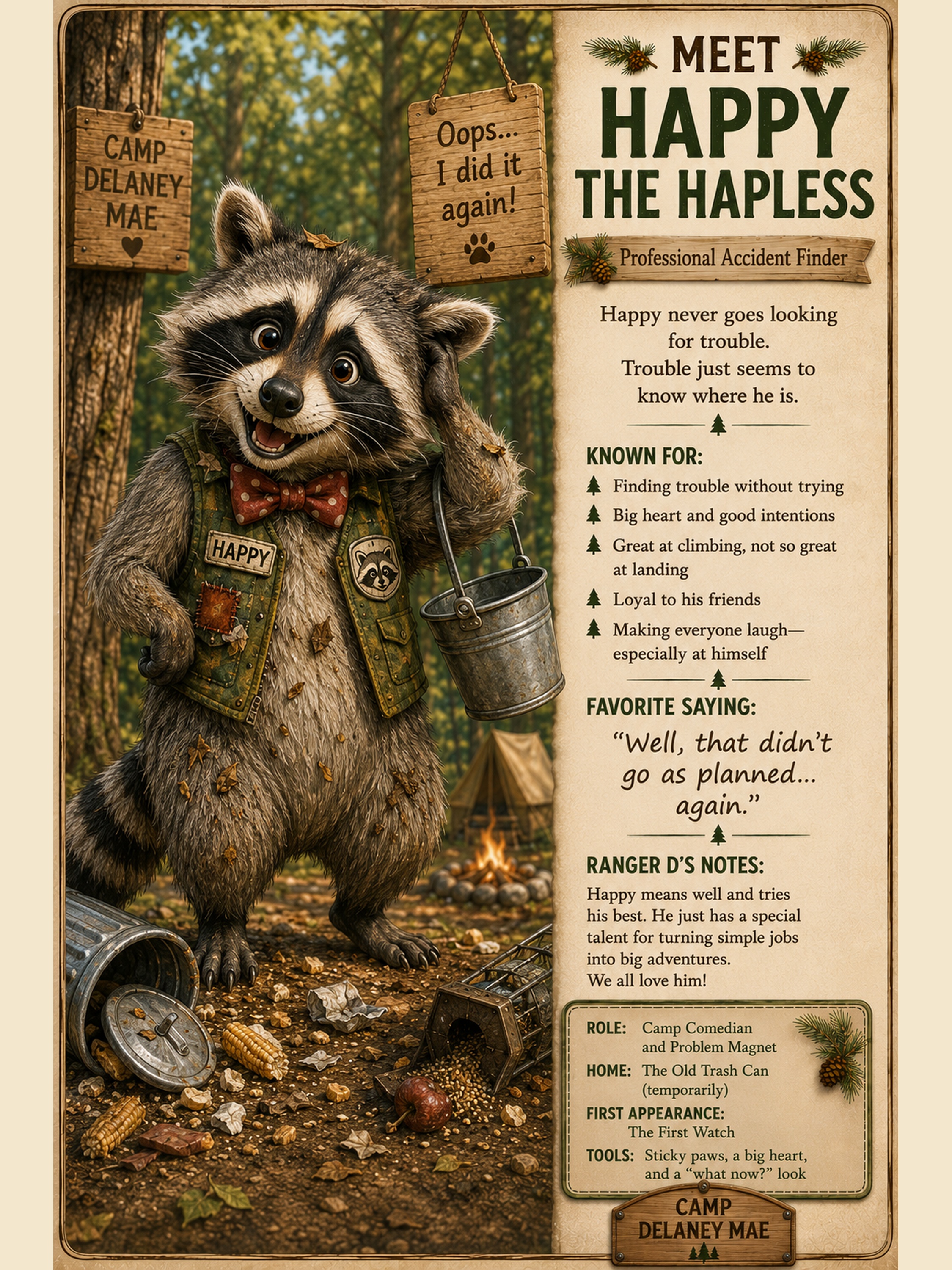
Happy throws himself into everything.
Happy rarely approaches anything halfway.
If there is a mystery, he wants to investigate it. If there is a rumor,
he wants to hear it. If there is an emergency, Happy is usually ready
before anyone has confirmed there actually is one.
In The Same Song, life returning to normal
includes Happy continuing to investigate things nobody asked him to investigate.
That may be the simplest description of Happy ever written.
Curiosity sometimes outruns his judgment.
Happy genuinely wants to know what is happening.
The problem is that sometimes he wants the answer before all the facts have arrived.
In The Hole Truth, Happy hurries through the Woodland
with a pencil and notebook, recording rumors as though they were facts because he hopes
to earn the reporter byline he has always wanted.
It is one of Happy’s weaknesses, but it is also part of what makes him grow.
Happy can make almost anything sound important.
Ordinary hunger becomes winter food reconnaissance.
A bag of marshmallows becomes an emergency supply.
And information that came from someone who heard it from someone who might have been nearby
can still become a Happy Raccoon report.
Happy does not necessarily mean to exaggerate.
Excitement simply gets there before caution does.
He is deeply loyal to his friends.
Happy may embarrass his friends, interrupt meetings, and occasionally make situations larger
than they need to be.
But he belongs to the Woodland completely.
When something happens, Happy wants to be part of helping.
Sometimes his help is useful.
Sometimes everyone would have been better off if he had waited five minutes.
But the intention usually comes from the right place.
Happy has a surprisingly tender heart.
One of the clearest glimpses under Happy’s fur comes through Robin’s Worm Cobbler.
Happy discovers that some new families do not particularly enjoy it.
Instead of letting Robin find the discarded cobblers and have her feelings hurt,
Happy quietly collects them and eats them himself.
When Sam and Howard finally catch him, Happy explains simply that Robin works hard
on the Welcome Baskets and would be hurt if she knew.
That moment tells us something important about Happy.
The jokes are loud.
His kindness usually is not.
Marshmallows remain a serious matter.
No Happy profile would be complete without them.
He keeps private emergency supplies. He adds them to Worm Cobbler.
He worries about imaginary marshmallow taxes.
Even when Phineas reports unusually high Worm Cobbler consumption,
the mention of marshmallow topping immediately turns every head toward Happy.
Some mysteries in Camp Delaney Mae may never be completely solved.
Happy’s relationship with marshmallows is probably one of them.
Happy may be the loudest raccoon in Camp Delaney Mae, but underneath all the commotion
is a curious, loyal, tenderhearted friend who cares far more deeply than he usually
lets anyone notice.
And if that caring happens to require an emergency bag of marshmallows...
Happy believes in being prepared.
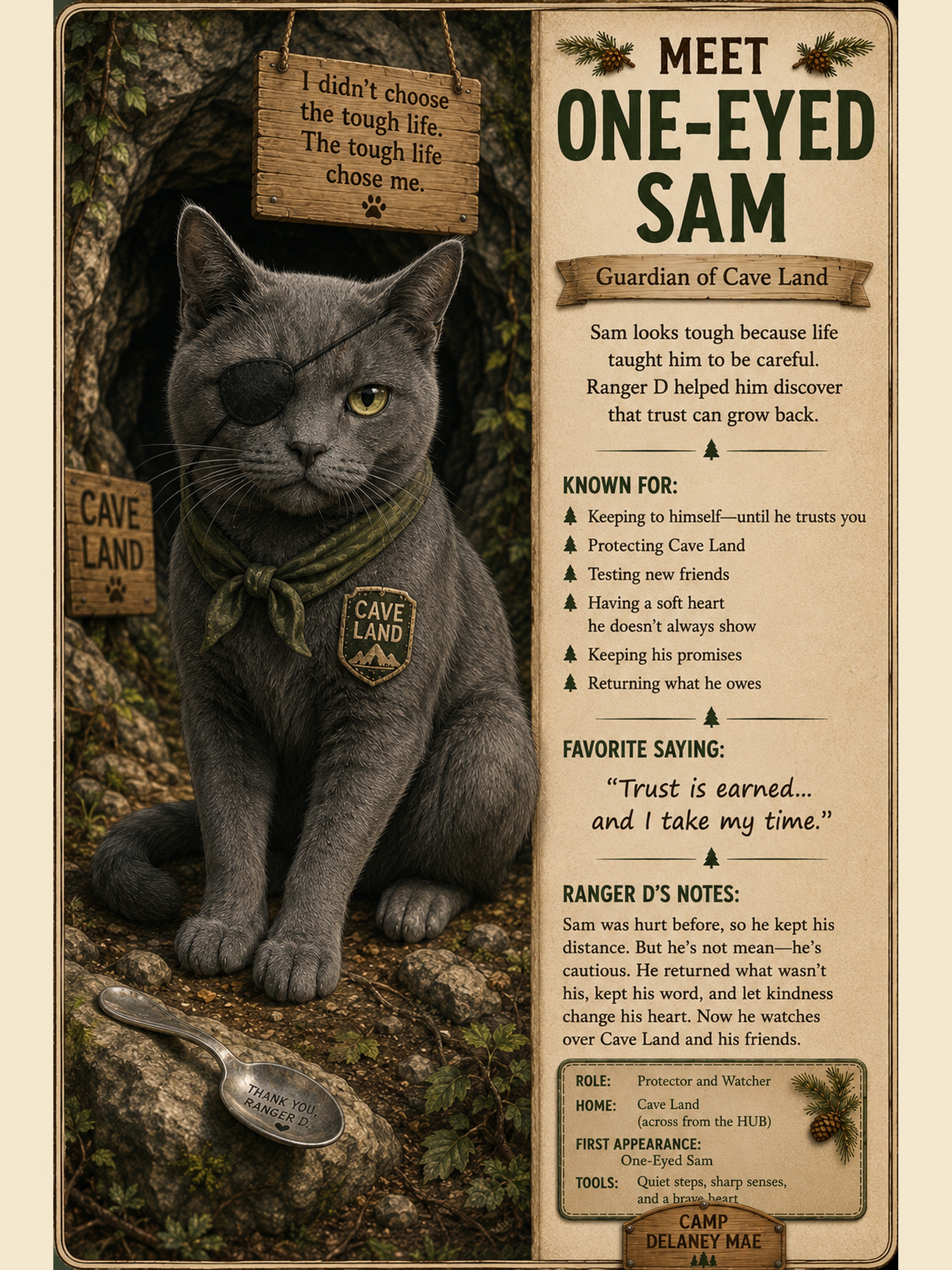
At first glance, One-Eyed Sam can be easy to misunderstand.
A rough gray cat. A ragged eye patch. A suspicious stare. And, especially in the beginning,
an attitude that suggested he would rather take what he needed than trust somebody enough
to give it to him.
But Sam did not become that cat for no reason.
Long before he found Camp Delaney Mae, Sam had known hunger, cold nights, and what it felt
like to be chased away before anyone bothered to know him. Somewhere along the way, he made
himself a promise: he would never be weak again.
To understand One-Eyed Sam, you have to look a little farther under the fur.
GUARDED
Sam learned to protect himself long before he learned to trust anyone else. Being suspicious
kept him from being hurt again—but it also kept kindness at a distance. Even when Ranger D
gave him food, a soft bed, and a safe place to rest, Sam struggled to believe that safety
could last. For the first time in a very long time, he felt almost safe—and a purr escaped
before he could stop it.
CURIOUS
Sam notices things. Always has. In the old days, curiosity was part of survival. He wanted
to know who came and went, where things were kept, which paths were watched, and how Camp
Delaney Mae worked. He told his raccoon scouts to watch everything.
Later, that same curiosity became useful. Give Sam an unanswered question and his notebook
will not stay closed for long.
PERSISTENT
Sam does not like unanswered questions—especially when the question involves Phineas Hopper XVI.
Long after the Scarlet Tangle trouble, Sam was still writing questions about Phineas in his
notebook, searching the Walnut Stump, checking roots, bark, and hiding places for clues.
Curiosity makes Sam ask. Persistence makes him keep looking.
CLEVER
Sam has always been good at putting pieces together. He once mapped Camp Delaney Mae in the
dust and used what he learned to make a very bad plan.
Today, that same mind makes him a natural investigator. He notices details, connects clues,
and knows when something simply does not add up. His cleverness never disappeared. He simply
learned that a sharp mind can be used for something better than getting your own way.
SENSITIVE
This may be the part of Sam he would least like everyone discussing.
Underneath the rough fur and tough attitude is a cat who feels things deeply. Mrs. O saw it
before Sam was ready to admit it. She had watched him relax in the bed Ranger D made for him.
She had heard the purr he tried to hide. Sam liked being cared for. He liked being safe.
Sometimes the creatures who work hardest to convince everyone they do not need anybody are
the ones who notice kindness the most.
CAPABLE OF CHANGE
Sam's most important characteristic may be this one.
Ranger D forgave him, but she did not pretend his choices had not mattered. Trust, she told
him, would have to grow back slowly.
And Sam began with something very small.
He returned a bent spoon and one dusty marshmallow he had taken during the raid. Nobody
ordered him to do it. Nobody was standing there waiting to praise him. Sam simply carried
them back and left them at the edge of camp.
It wasn't a grand gesture.
It was one good choice.
And sometimes that is how change begins.
One-Eyed Sam is still One-Eyed Sam.
He is suspicious. He asks too many questions. He can become completely obsessed with a
mystery, and Phineas Hopper XVI may never know a moment's peace as long as Sam owns a notebook.
But the Woodland eventually discovered something important beneath that rough gray fur:
Being hurt can change someone.
Being loved can change them too.
And neither their wounds nor their worst mistakes determine all that they are capable of becoming.